Writing Instruction: A Cat With Nine Lives Hanging On By Its Tail in Texas

"What I saw for years was that because it was only tested in fourth and seventh grade, students would only get explicit writing instruction in fourth and seventh grade," she said. "And so as a seventh-grade teacher, I would be scrambling to try to figure out how can I cover all of these grammar mechanics? How do I cover all of these writing techniques? What can I drop? What do we need to focus on?" (Erika De La Rosa, Texas teacher, February 29, 2024)
When the Texas Education Agency (TEA) first announced its partial transition from multiple-choice to constructed-response items on its statewide tests before it began considering machine scoring, English teachers like Erika De La Rosa saw a silver lining.
Legislation early in the 2020s required TEA to reduce its reliance on multiple-choice items in favor of constructed-response items. Students would have to write in every grade if only in response to their reading. Researchers in writing assessment have long documented the unfortunate consequences of grade-level targeting of writing. Those are the grades where writing is taught.
Perhaps requiring students to write constructed responses to reading passages at each grade level would stimulate writing instruction more broadly. But those early glimpses of hope were dashed when teachers learned that assessment would be accomplished by an automated scoring machine.
Writing as authoring original texts apart from reading a passage, however, would not be assessed. TEA would instead pair all writing with passages to be read, another move that traditionally elevates reading above writing. The Common Core State Standards were built from the assumption that students learn to write through analyzing texts written by someone else and synthesizing, interpreting, or viewing the information as evidence in an argument.
Looking under the hood of precisely how these extended constructed responses (ECR) are scored under TEA mechanisms provides good reason to suspect that robust writing instruction in Texas is being distorted in the curriculum in two ways. First, no serious educator defines writing as what students do to provide evidence of comprehension of a text. Second, when even that performative use of writing is scored by an automated scoring machine, what must count as effective writing becomes a thesis-driven five paragraph essay, a cookie cutter approach that makes automation less prone to wild errors.
The following discussion focuses on the TEA-released sample extended construction response item from Spring 2025. An analysis of the ECR prompt itself as well as the scoring guide suggests that the sort of writing Texas has in mind comes from a perspective on composition that predates process writing research begun in the 1980s.
Though this approach makes room for automated scoring, it fails miserably in doing what Erika De La Rosa hoped for, namely, a thorough redirection from teaching writing as a sometime thing in fourth and seventh grade to teaching writing as a fundamental focus of schooling every day across the curriculum.
What the TEA Prompt for the ECR Writing Task Tells Us
Grade 8 Reading Extended Constructed Response
Prompt
Read the article “Seeing in a Sea of Snow.” Based on the information in the article, write a
response to the following:
Explain what the invention of snow goggles reveals about ancient cultures.
Write a well-organized informational composition that uses specific evidence from the article
to support your answer.
Remember to —
• clearly state your thesis
• organize your writing
• develop your ideas in detail
• use evidence from the selection in your response
• use correct spelling, capitalization, punctuation, and grammar
Manage your time carefully so that you can —
• review the selection
• plan your response
• write your response
• revise and edit your response
Write your response in the box provided.
This is a writing prompt that is mostly about reading. Consider how.
The task itself
“Based on the information in the article” and “Explain what the invention of snow goggles reveals” anchor the intellectual work entirely in the source text. The student isn’t asked to bring anything to the task beyond the ability to read, comprehend, and draw inferences.
There’s no invitation to reason, imagine, extrapolate, or criticize beyond the article, to connect to prior knowledge, or to form an independent interpretive position. The thesis the student is supposed to “clearly state” is already implied by the prompt — snow goggles reveal something about ancient cultures — so the student is really being asked to retrieve and organize, not to argue, a directive that distorts any habitual or typical way of reading the student might deploy.
I’ve come to think of these kinds of tasks as the “David Coleman Special.” Asked about the role of the student in the Common Core State Standards, which he developed as the project chief, he responded that high school students simply need to accept the fact that “nobody gives a sh**t about what you think or feel.”
The checklist
Of the five “Remember to’s,” three are explicitly reading-dependent or text-dependent (”clearly state your thesis” means state the one the prompt set up, “develop your ideas in detail” means elaborate on the article’s content, “use evidence from the selection” is direct retrieval). Only spelling, capitalization, punctuation, and grammar are purely writing concerns and those are conventions, not composition.
The time management bullets
The first four steps are highly misleading. “Review the selection” means “reread and reorganize the content,” which is not the first step in any robust academic writing project. “Plan” is also ambiguous. Indeed, a savvy test-taker would have begun planning the essay during the first cold reading, an external injection into the reading process that influences the student in unpredictable ways.
“Write, revise.” Writing in this sense means “generate language to fill a predetermined structure for a predetermined purpose to earn a grade from a machine.”
In writing pedagogy, "write" typically means discovery. Elbow's (1973) notion that writing precedes knowing, that composing is how thought gets made, not how finished thought gets recorded, is ignored. Murray (1978) called this "writing to learn."
Revision, for Sommers (1980), means genuinely re-seeing, restructuring an argument, rethinking claims, sometimes abandoning drafts entirely. Flower and Hayes (1981) showed that skilled writers recursively plan, draft, and revise simultaneously, not sequentially.
None of that is available here. The prompt's "write" means fill the predetermined container; its "revise" means fix surface errors. Both words are borrowed from writing pedagogy while being depleted of their meaning.
What’s missing
Nothing in the prompt asks the student to do anything a writer actually does — no stance-taking beyond what the prompt dictates, no consideration of audience, no decisions about what to include or exclude from their own thinking, no writerly judgment of any kind. The “well-organized informational composition” framing sounds like a writing task, but the organizational work is constrained entirely by what the article contains.
The core problem
This is essentially a reading comprehension task with a writing delivery mechanism. The rubric rewards thesis clarity, organization, evidence explanation, and word choice, but the content of all four is determined by the source text, not by the writer. A student who reads carefully and summarizes coherently will score well. A student who writes beautifully but wanders from the article will not. That’s a reading assessment dressed in writing clothes.
What the Rubric for the TEA Extended Construction Response Tells Us
Grade 8 Reading Passage with Extended Constructed Response Informational Writing Rubric
Organization and Development of Ideas
3 • Controlling idea/Thesis is clear and fully developed
The controlling idea/thesis is clearly identifiable. The focus is consistent
throughout, creating a response that is unified and easy to follow.
• Organization is effective
A purposeful structure that includes an effective introduction and
conclusion is evident. The organizational structure is appropriate and
effectively supports the development of the controlling idea/thesis. The
sentences, paragraphs, or ideas are logically connected in purposeful
and highly effective ways.
• Evidence is specific, well chosen, and relevant
The response includes relevant text-based evidence that is clearly
explained and consistently supports and develops the controlling
idea/thesis. For pairs in grades 6 through EII, evidence is drawn from
both texts. The response reflects a thorough understanding of the
writing purpose.
• Expression of ideas is clear and effective
The writer’s word choice is specific, purposeful, and enhances the
response. Almost all sentences and phrases are effectively crafted to
convey the writer’s ideas and contribute to the overall quality of the
response and the clarity of the message.
2 • Controlling idea/Thesis is present and partially developed
A controlling idea/thesis is presented, but it may not be clearly
identifiable because it is not fully developed. The focus may not always
be consistent and may not always be easy to follow.
• Organization is limited
A purposeful structure that includes an introduction and conclusion is
present. An organizational structure may not be consistent and may not
always support the logical development of the controlling idea/thesis.
Sentence-to-sentence connections and clarity may be lacking.
• Evidence is limited and may include some irrelevant information
The response may include text-based evidence to support the controlling
idea/thesis, but it may be insufficiently explained, and/or some evidence
may be irrelevant to the controlling idea/thesis. For pairs, evidence is
drawn from at least one of the texts. The response reflects partial
understanding of the writing purpose.
• Expression of ideas is basic
The writer’s word choice may be general and imprecise and at times
may not convey the writer’s ideas clearly. Sentences and phrases are at
times ineffective and may interfere with the writer’s intended meaning
and weaken the message.
Texas Education Agency
Student Assessment Division
2025 7Grade 8 Reading Language Arts
Constructed-Response Scoring Guide
1 • Controlling idea/Thesis is evident but not developed
A controlling idea/thesis is present but not developed appropriately in
response to the writing task.
• Organization is minimal and/or weak
An introduction or conclusion may be present. An organizational
structure that supports logical development is not always evident or is
not appropriate to the task.
• Evidence is insufficient and/or mostly irrelevant
Little text-based evidence is presented to support the controlling
idea/thesis, or the evidence presented is mostly extraneous and/or
repetitious. Explanation of any evidence presented is insufficient and
may be only vaguely related to the writing task. For pairs in grades 6
through EII, evidence is drawn from only one text. The response reflects
a limited understanding of the writing purpose.
• Expression of ideas is ineffective
The writer’s word choice is vague or limited and may impede the quality
and clarity of the essay. Sentences and phrases are often ineffective,
interfere with the writer’s intended meaning, and impact the strength
and clarity of the message.
0 • A controlling idea/thesis may be evident.
• The response lacks an introduction and conclusion. An organizational
structure is not evident.
• Evidence is not provided or is irrelevant.
The response reflects a lack of understanding of the writing purpose.
• The expression of ideas is unclear and/or incoherent.
Please note that if a response receives a score point 0 in the
Development and Organization of Ideas trait, the response will also
earn 0 points in the Conventions trait.
The rubric systematically rewards a particular cognitive style, one that keeps the source text at the center of the composing process at every stage. Here’s how that plays out across each dimension:
Controlling Idea/Thesis
The rubric calls for a thesis that is “clearly identifiable” and “fully developed.” But developed from what? The only available material is the article. A student who generates a thesis from their own prior knowledge about indigenous ingenuity, or who reasons independently about what material culture reveals about ancient societies, has no way to anchor that thesis in the rubric’s terms. “Thorough understanding of the writing purpose” means thorough understanding of the article’s purpose — the two are collapsed into one. The student who stays closest to the text has the clearest thesis almost by definition.
Organization
“Logically connected in purposeful and highly effective ways” sounds like a writing criterion, but in this context logical connection means following the article’s own organizational logic. The article moves from problem to invention to design to effectiveness — a student who mirrors that structure will naturally produce something that reads as purposeful. The rubric cannot distinguish between organization that emerges from the writer’s own rhetorical decisions and organization that is borrowed from the source text’s structure. The text-dependent writer gets credit for the article’s organization.
Evidence
This is where the privilege is most explicit and most consequential. “Specific, well chosen, and relevant” evidence at score point 3 requires the student to be continuously referencing the text — selecting, quoting or paraphrasing, then explaining the connection to the thesis. This is a reading behavior masquerading as a writing behavior. The cognitive demand is primarily retrieval and selection from a fixed source, not the generative act of finding and marshaling evidence from one’s own knowledge or experience. “Insufficiently explained” at score point 2 penalizes students who cite evidence competently but move away from the text too quickly to develop their own thinking. The rubric essentially taxes independent thought by treating departure from the text as incompleteness.
Expression of Ideas
“Specific, purposeful” word choice at score point 3 will almost inevitably be rewarded in students who are borrowing the article’s vocabulary. The article about snow goggles could have used precise technical and domain language — photokeratitis, ultraviolet, corrective lenses, Arctic, millennia. A student who absorbs and redeployes that language will appear to have specific and purposeful word choice.
A student who writes fluently in their own register, using general but accurate language, risks the “general and imprecise” characterization of score point 2. The rubric cannot see the difference between a student who owns precise language and one who is reflecting the text back.
The automated scoring problem
The rubric’s text-dependence is compounded by the fact that TEA uses a hybrid automated scoring engine. Automated scoring systems are trained on features like lexical overlap with the source text, keyword density, and structural markers. A student whose essay closely mirrors the article’s language and structure will score well not because they are a better writer but because they are a more compliant text-processor. The machine rewards proximity to the source, which means the rubric’s implicit privileging of text-dependent behavior is amplified by the scoring mechanism.
What the rubric cannot see
It cannot reward a student who synthesizes independently, who brings genuine prior knowledge to bear, who takes an unexpected but defensible interpretive position, or who writes with distinctive voice. All of those are writing virtues in any other context. Here they are liabilities unless they are tethered to the article at every turn. The student who reads the article once, forms a genuine intellectual response, and writes from that response will almost certainly underperform the student who reads the article twice, maps its structure, and builds a response by shuttling back and forth between text and draft.
The deeper issue
The rubric describes a transaction, not a composition. The student’s job is to receive information from the article and return it in organized form with connective tissue added. That is a legitimate academic skill — it is roughly what a researcher does when summarizing sources — but it is not what writing pedagogy means by composing, and it is not what the rubric’s own language (”writer’s word choice,” “writer’s ideas,” “the writer”) implies about the nature of the task. The language of authorship is applied to what is fundamentally an act of managed retrieval.
The article "Seeing in a Sea of Snow" as it appears on the STAAR test is likely a TEA-commissioned or licensed piece based on my experiences working with large-scale assessment efforts, which is standard practice to avoid students having prior exposure to the text. I can’t find it as a standalone article.
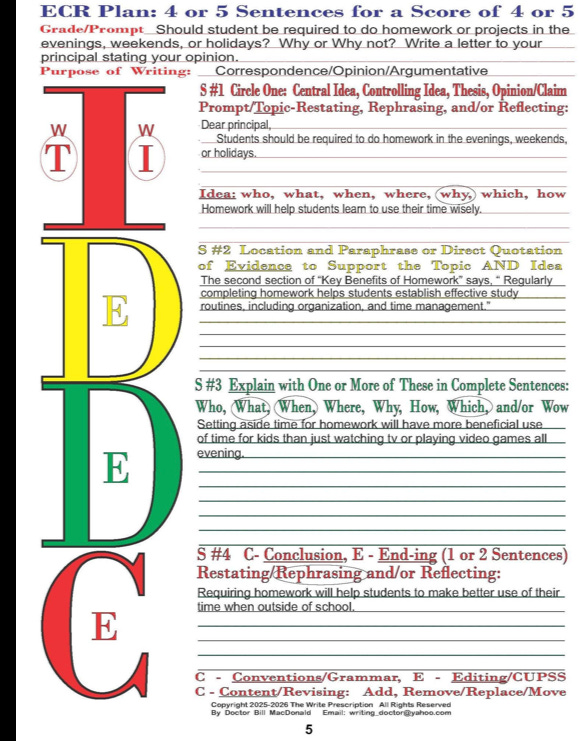
This image was found on Facebook, which hosts a group of interested educators titled “The ELAR/SLAR & WRITE Prescription Club 2025-2026” with 13,000 members. It is dedicated to decoding the subtle cues in the TEA prompts that reveal what the prompt wants and then translating those cues into kid-friendly tips. This particular graphic was created by Bill MacDonald, I believe.
Writing: A Cat with Nine Lives in Danger in Texas
Life 1 Gone: Writing disappears as a subject.
The most immediate threat is curricular. When writing is assessed only as a delivery mechanism for reading comprehension, it stops being taught as a discipline with its own logic, history, craft traditions, and intellectual demands. Erika De La Rosa’s observation — that writing instruction was concentrated in tested grades — describes what happens when assessment drives curriculum.
If the new system assesses writing at every grade but only as a reading response, the same contraction happens again, just more evenly distributed. Teachers will teach students to produce reading responses, not to write. The subject called writing will exist in name only.
Life 2 Gone: Process writing research becomes irrelevant.
Forty years of research established that writing is a cognitive process embedded in a social setting, not a product. That research changed classroom practice. This assessment framework reverses the gains by treating writing as product delivery.
When the test defines writing as filling a predetermined container with retrieved content, teachers who teach process — drafting, discovery, revision as re-seeing — are teaching toward a different test that will not reward and may actually penalize. The rational teacher, under accountability pressure, abandons process. The research becomes professionally irrelevant.
Life 3 Gone: The five-paragraph essay is permanently institutionalized.
The rubric’s architecture — thesis, organized body, conclusion, text-based evidence, conventional correctness — describes and rewards exactly one form: the thesis-driven five-paragraph essay. That form has been criticized for decades not because structure is bad but because the five-paragraph essay teaches students that structure precedes thought, that the container is fixed before the content is known.
Applebee (1984) documented its dominance. Hillocks (2002) argued it actively impedes genuine argumentation. This rubric makes any other form risky. A student who writes a genuine argument with a complex structure that doesn’t front-load a thesis faces a scoring penalty. The form is now backed by the authority of the State of Texas.
Life 4 Gone: Automated scoring makes the threat permanent and self-reinforcing.
Machine scoring rewards the five-paragraph essay and it trains future scoring on it. The hybrid model TEA uses builds its automated engine on human-scored anchor papers. If those anchor papers are themselves the product of a rubric that rewards text-dependent thesis-driven prose, the machine learns that writing is text-dependent thesis-driven prose.
Each generation of test-takers produces training data that further calcifies the definition. There is no corrective mechanism. Unlike a human reader who might notice and reward unexpected excellence, the machine cannot be surprised. Voice, originality, intellectual risk, genuine argument — none of these generate signals the machine is trained to see.
Over time the population of Texas writers is shaped toward what the machine rewards, and the machine is retrained on that shaped population. It is a closed loop that tightens with each iteration.
Life 5 Gone: Audience disappears
Every serious writing researcher and theorist — from Britton (1975) to Nystrand (1997) — has argued that writing is fundamentally a social act, that writers write for readers, and that the awareness of audience is central to rhetorical development. This assessment has no audience.
The student writes for a machine that has no comprehension, no stake in the content, no capacity to be persuaded or informed or moved. The prompt does not name an audience. The rubric does not mention audience. A student who writes with genuine communicative intent, who imagines a reader and makes choices accordingly, receives no credit for that intent.
Writing as communication is replaced by writing as compliance. That replacement, absorbed by students across thirteen years of schooling, produces adults who understand writing as performance for institutional authority rather than as a means of acting in the world.
Life 6 Gone: Indigenous and non-dominant voices are structurally disadvantaged.
The article about snow goggles is, ironically, about indigenous ingenuity, but the assessment framework surrounding it reproduces the very epistemic hierarchy that historically silenced indigenous knowledge.
A student from an Alaska Native community who knows this history deeply, whose family carries this knowledge, cannot use that knowledge. It is not in the article. The rubric will penalize its appearance as evidence because it is not text-based.
The student who knows the most about the subject is required to set that knowledge aside and defer to a TEA-commissioned article. This is a structural reproduction of the conditions under which indigenous knowledge has always been devalued in institutional settings. The institution’s text supersedes the community’s knowledge.
Life 7 Gone: Writing as thinking is severed.
Vygotsky’s foundational insight, that language and thought are not separate, that writing is a tool for developing cognition, is operationally negated by this framework. Writing-to-learn, which has extensive research support from Emig (1977) through Klein (1999) and beyond, requires that the writer discover something through the act of writing that they did not know before they began.
This assessment forecloses that possibility by design. The content is determined before writing begins. The structure is determined before writing begins. The thesis is implied by the prompt before writing begins. There is nothing left for writing to do except transcribe what reading has already produced. Students trained exclusively in this mode learn that writing does not generate thought; it merely packages it. That is a catastrophically impoverished model of what writing is for.
Life 8 Gone: The teacher is deskilled.
When the rubric is this prescriptive and the scoring is automated, the teacher’s professional judgment becomes irrelevant to the outcome. The Facebook page referenced earlier is heart-breaking in its depiction of teachers working desperately to defend their students against scores of zero while salvaging what they can in the name of quality instruction.
A teacher who reads student writing with attention to voice, development of ideas over time, rhetorical sophistication, genre awareness, or genuine argumentation is developing capacities the test cannot see. The test rewards a narrow, specifiable, machine-detectable set of features.
The tragedy is that teachers who align their instruction to those features are not teaching writing. They are teaching test compliance. Teachers who resist and teach writing as a full discipline are working against the incentive structure. Over time the profession loses its capacity to recognize and reward genuine writing development because the institutional definition of writing has narrowed to what the machine can score.
Life 9 Gone: The cumulative effect
Taken together, these threats describe not just a bad test but a redefinition of literacy itself. If this framework operates at every grade level across the state, an entire generation of Texas students will have been taught that writing means reading carefully and reporting back in organized prose with a thesis stated upfront and evidence cited from the approved source.
That is a specific and limiting conception of what it means to be literate. It excludes expressiveness, argumentation from personal knowledge and experience, genre diversity, audience awareness, writerly voice, and the fundamental experience of discovering what you think by writing. Those exclusions are the logical consequence of a system designed to make writing machine-scorable, and they represent a genuine narrowing of what it means to be an educated person.
The Stakes Couldn’t Be Higher
Texas public education is already staggering under a storm of litigation — over school finance, over book bans, over vouchers draining public school funding. Add to that storm this potentially more damaging assault: the systematic redefinition of literacy itself in the name of administrative efficiency.
While legislators and pundits warn endlessly about artificial intelligence threatening the integrity of student writing, the far greater threat is the one TEA has already institutionalized, a machine-scored, text-dependent, five-paragraph-essay factory that has preemptively answered the AI problem by eliminating genuine writing altogether.
The irony is devastating. We are told that AI threatens writing because machines can now produce human-sounding prose. TEA’s response is to assess writing in a way that rewards students for writing like machines, for retrieving, organizing, and returning information in a predetermined structure for a non-human reader. The cure is the disease.
Ours is not a technical problem with an engineering solution. It is a failure of will and a lack of leadership, a decision to sell children’s literacy futures for the convenience of scalable scoring. It ignores everything we know about how human beings develop as thinkers through language.
Erika De La Rosa was right to hope. She was right to be disappointed. The obligation now is to keep saying clearly what is being lost before the generation that never learned to write inherits the consequences.